
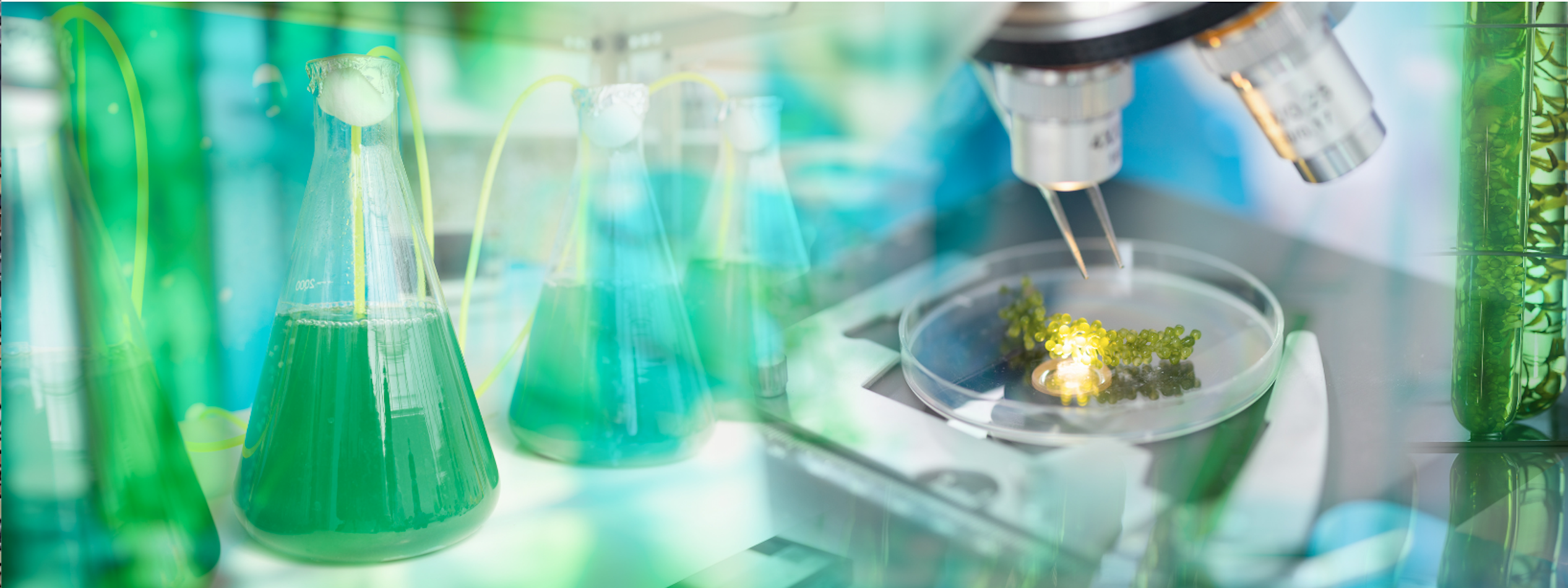
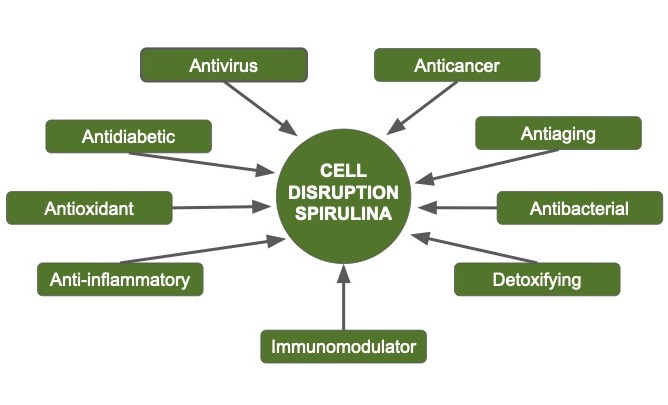
Cell disruption® technology spirulina extract – technology that completely breaks down spirulina algae cells into small fragments, releasing biologically active ingredients into the medium – vitamins, carotenoids, chlorophylls, proteins, amino acids, etc. The result is a greater amount of beneficial spirulina ingredients extracted and the more finely the spirulina is broken down, the more open cells appear from which beneficial ingredients are extracted.
Science
Spirulina Platensis (Cyanobacterium or Arthrospira Platensis) – The common name spirulina refers to the dried biomass of algae, which belongs to photosynthetic bacteria that include the cyanobacteria and prochlorophyte groups. A colony of cyanobacteria surrounded by a strong multi-layered membrane that twists to form a spiral. The bluish color is given by the pigment phycocyanin, one of the most valuable elements of spirulina for humans. Officially, spirulina microalgae is recognized by the WHO (World Health Organization) as an ideal food for mankind due to its high nutritional value and balanced complex of vitamins, minerals, and amino acids. Spirulina is rich in the blue pigment phycocyanin, the only substance known in the world that can stop the proliferation of cancer cells.
Spirulina Platensis (lot. Arthrospira Platensis)
| RMV - reference nutritional value per 100g. | |
|---|---|
| Carbs | 23,9 |
| Sugar | 3,1 |
| Fibers | 3,6 |
| Fats: | 7,72 |
| - Saturated | 2,65 |
| - Monosaturated | 0,675 |
| - Polyunsaturated | 2,08 |
| Proteins | 57,47 |
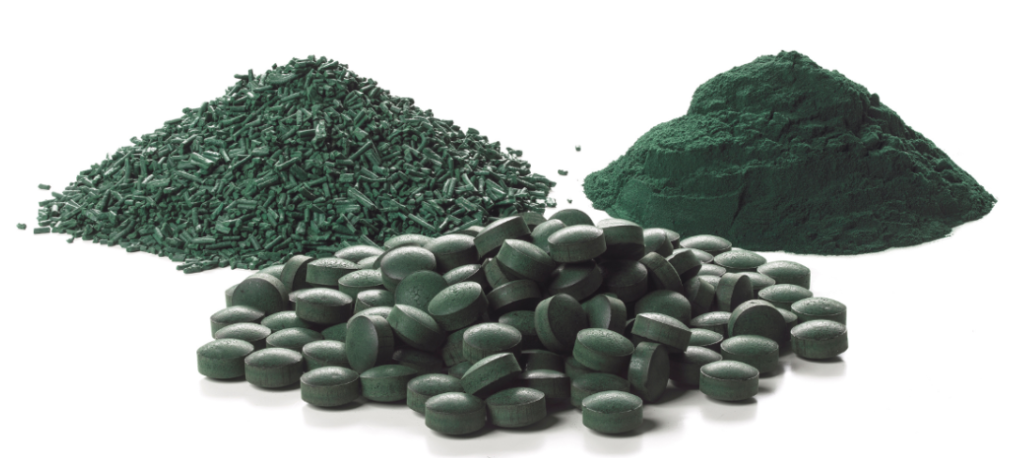
Gamma linolenic acid is found only in milk and spirulina. It regulates many body functions: arterial pressure, cholesterol synthesis, and cell and central nervous system function restoration. Algae contains a lot of folic acid, which is necessary for the formation of hemoglobin and proteins of high biological value, the absorption of which is up to 90%. In addition to the usual minerals, trace elements and vitamins, spirulina is especially rich in pigments.
Nutritional value of Arthrospira Platensis 100g
Amino acids are substituted
| Isoleucine | 3,209 g |
| Leucine | 4,947 g |
| Lysine | 3,025 g |
| Methionine | 1,149 g |
| Phenylalanine | 2,777 g |
| Threonine | 2,97 g |
| Tryptophan | 0,929 g |
| Valine | 3,512 g |
Essential amino acids
| Alanine | 4,515 g |
| Arginine | 4,147 g |
| Aspartic acid | 5,793 g |
| Cystine | 0,662 g |
| Glutamic acid | 8,386 g |
| Glycine | 3,099 g |
| Histidine | 1,085 g |
| Proline | 2,382 g |
| Serine | 2,998 g |
| Tyrosine | 2,584 g |
Fatty acids
| Gamma-linolenic acid | 1,5 g |
| Linoleic acid | 1,3 g |
| Oleic acid | 12 mg |
| Stearic acid | 8 mg |
| Hepatadecanoic acid | 2 mg |
| Palmitoleic acid | 33 mg |
| Palmitic acid | 244 mg |
Phytonutrients
| Phycocyanin | 12000 mg |
| Chlorophyll | 1250 mg |
| Carotenoids | 450 mg |
| Glycolipids | 200 mg |
| Sulfolipids | 10 mg |
Vitamins
| Thiamine (B1) | 2,38 mg |
| Riboflavin (B2) | 3,67 mg |
| Niacin (B3) | 12,82 mg |
| Vitamin B6 | 0,364 mg |
| Vitamin B12 | 183,3 μg |
| Folic acid (B9) | 94 μg |
| Pantothenic acid (B5) | 3,48 mg |
| Choline | 66 mg |
| Vitamin C | 10,1 mg |
| Vitamin D3 | 0,1 mcg (4.0 IU) |
| Vitamin E | 5 mg |
| Vitamin K | 25,5 μg |
Minerals
| Iron | 28,5 mg |
| Calcium | 120 mg |
| Phosphorus | 118 mg |
| Magnesium | 195 mg |
| Copper | 0,5 mg |
| Manganese | 1,9 mg |
| Sodium | 517 mg |
| Potassium | 1546,7 mg |
| Selenium | 0,2 mg |
| Zinc | 2 mg |
The most valuable components of spirulina
Based on global studies, the potential of spirulina’s effect and use has been highlighted:
- destroys most viruses and kills pathogenic microbes;
- compensates for the lack of vitamins and minerals;
- promotes wound healing and cell regeneration;
- has enzyme activity, reduces bad cholesterol;
- protects against radiation exposure;
- normalizes metabolic processes;
- strengthens the immune system and the body’s resistance;
- has anti-allergic and anti-cancer effects;
- removes heavy metals, toxins, radionuclides from the body;
- has a preventive effect against atherosclerosis and coronary artery disease;
- great potential for use as a treatment for protein deficiency or for parenteral nutrition;
- received positive results in studies of improving metabolism, general nutritional status;
- no toxicity, either acute or chronic, can be safely used as a human food product.
https://www.lsmuni.lt/cris/bitstream/20.500.12512/100142/1/Kimutis.pdf; Hindawi Publishing Corporation Evidence-Based Complementary and Alternative Medicine Volume 2016, Article ID 7803846, 14 pages;
Scientific sources:
https://www.ncbi.nlm.nih.gov/pmc/articles/PMC4879233/
https://www.ncbi.nlm.nih.gov/pmc/articles/PMC5687155/
https://link.springer.com/article/10.1186/s12935-018-0511-5
https://www.nature.com/articles/s41598-019-55605-w
https://pubmed.ncbi.nlm.nih.gov/31844085/
https://link.springer.com/article/10.1007/s11274-010-0516-2
https://www.ncbi.nlm.nih.gov/pmc/articles/PMC7130854/
https://europepmc.org/article/cba/295843
https://pubmed.ncbi.nlm.nih.gov/19914399/
https://www.e-algae.org/m/journal/view.php?number=2817
http://www.spirulinasource.com/2013/03/spirulina-benefits-against-radiation/
